News briefing · November 2026
AI and design briefing: what to try after the 2026 tool announcements
A November 4 briefing on Figma’s evolving workflows, Google Stitch, Penpot MCP, and Make AI Agents—with practical experiments for UX teams.
In this guide
- The useful starting point
- A dated briefing, with experiments attached
- October 15: Figma’s broader design-and-build direction
- Current Figma MCP documentation: agents can write to the canvas
- March 18: Google expanded Stitch’s design canvas
- Current Penpot documentation: an open-source MCP route
- February 11: Make announced its next generation of AI Agents
- What to watch next
- Sources and further reading
The useful starting point
The useful question after an AI design announcement is which part of your workflow it improves. Test one capability against a real task, and keep announcement dates separate from current documentation.
A dated briefing, with experiments attached
Reviewed November 4, 2026. This is a selected briefing, not a claim to cover every release. Dates below identify the announcement when one is available. Current documentation checks are labeled separately. Product availability can differ by plan, client, and rollout.
October 15: Figma’s broader design-and-build direction
Figma’s Build by design announcement describes new workflows across teams, agents, design, code, and context. Its useful framing separates exploratory building from work intended to ship. Our interpretation: teams need to state which mode they are in before evaluating an AI-generated result.
Try this: give one prototype two checklists. The first asks whether it answers a design question. The second asks whether it can handle real data, failure, permissions, and support. Use the difference to plan the next work instead of treating a polished preview as a release.
Current Figma MCP documentation: agents can write to the canvas
The official documentation now describes native canvas creation and editing through the remote MCP server. Writing remains beta and subject to access requirements. This extends the workflow beyond extracting a frame for code generation.
Try this: duplicate a small file, ask an assistant to inventory the components, and create one error-state variation. Compare component reuse and resizing before adopting it for broader work. Use our Figma MCP tutorial.
March 18: Google expanded Stitch’s design canvas
Google’s announcement describes an AI design canvas with a design agent, interactive prototyping, and exchange of design-system context through DESIGN.md. These are capabilities to evaluate, not independent evidence of better usability.
Try this: express the same brief in your current tool and in Stitch. Compare the work required to reach an editable, reviewable result. Keep content and task identical so the comparison is meaningful.
Current Penpot documentation: an open-source MCP route
Penpot documents remote and local MCP connections for design work. The hosted route connects a trusted assistant to the focused design page.
Try this: build a tiny token set and a four-state settings screen. Ask a teammate to edit it. The question is whether the resulting file is maintainable in your workflow. Follow our Penpot workshop.
February 11: Make announced its next generation of AI Agents
Make’s announcement brings agents into its visual scenario environment. The current help center labels the new app open beta and documents testing alongside scenario building.
Try this: turn approved research notes into an evidence-linked draft brief that stops in a review queue. Keep external messages outside the initial experiment. See the Make.com design workflow.
What to watch next
Our editorial watchlist is practical: clearer access terms, reliable component reuse, portable design context, transparent failure handling, and easier evaluation. A new model name alone does not answer those questions. Record setup effort, correction effort, and the quality of the final artifact when comparing tools.
For the longer view, read our 2027 UX and design predictions, which are explicitly forecasts rather than announced product plans.
Sources and further reading
- Figma: Build by design, October 15, 2026
- Figma: write to canvas and current limitations
- Google Labs: Stitch design canvas, March 18, 2026
- Penpot: official MCP setup and capabilities
- Make: next-generation AI Agents announcement, February 11, 2026
- Make: current app overview
Sources checked November 4, 2026. Review the linked publisher information for current details.
Put one idea to work
Take the next step with a practical worksheet, a clear research question, and a standard you can use to review the work.
Explore design worksheets →Explore more from UX Design CoachGet design practice in your inbox →Keep practicing
 Build & prototype · Working with agents
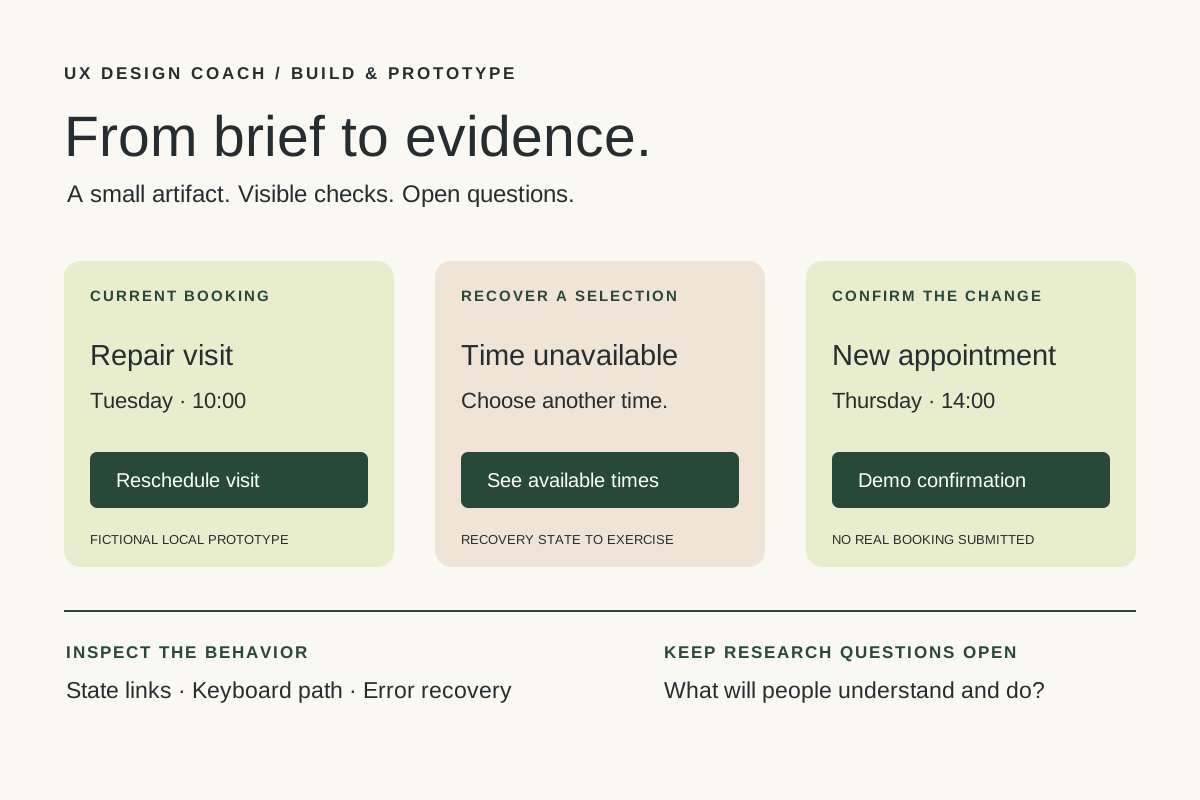
From design brief to reviewable prototype: inference and the agent harness
Use a bounded prototype exercise to understand inference, agent harnesses, tool checks, and the human research still needed. Includes a copyable design task card.
November 5, 2026 · 7 min read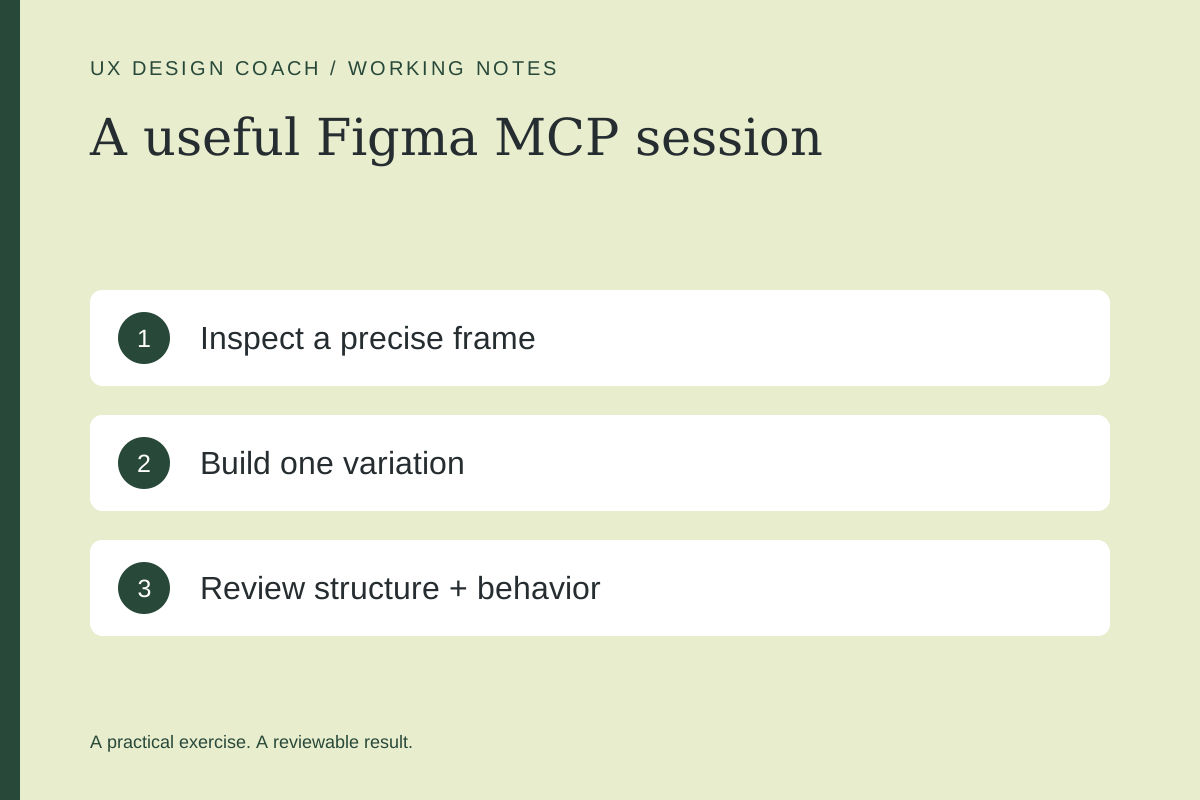 Tool workshop · Figma MCP
Figma MCP: turn your design system into a working AI partner
Connect Figma to an AI assistant, inspect a real frame, create a controlled variation, and check the handoff. Includes setup, prompts, and a troubleshooting checklist.
November 4, 2026 · 3 min read