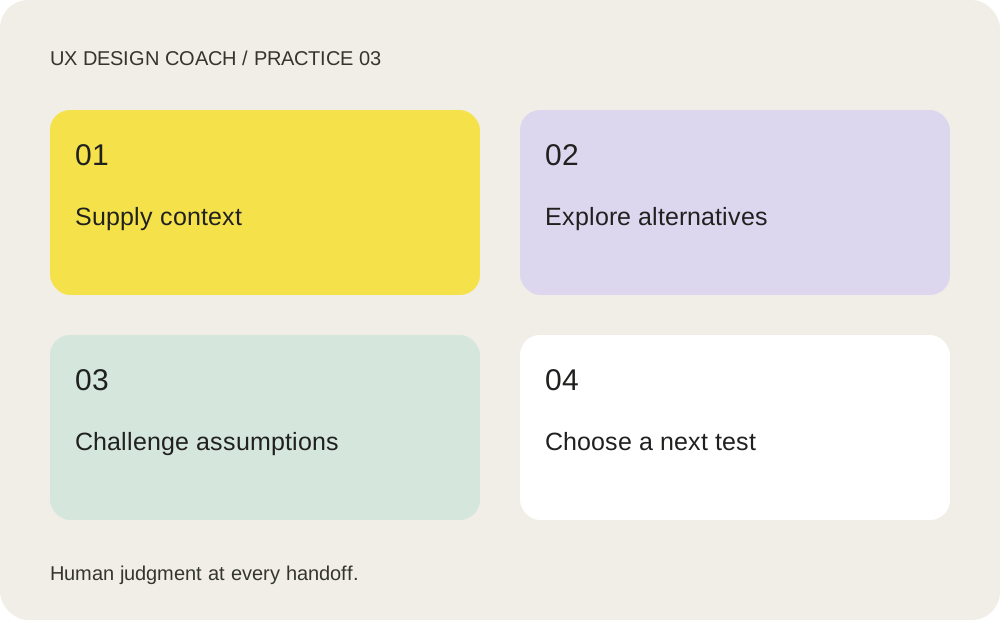
Do the work, step by step
- Choose the Astra model if available in your account and attach a bounded brief, relevant screens and the actual product rules. Record the displayed model name and date for reproducibility.
- Ask for two meaningfully different approaches: a short single-page booking form and a staged flow, for example. Require tradeoffs and unresolved questions for each.
- Critique against the same rubric: task clarity, interaction states, content accuracy, accessibility questions and implementation constraints. Ask the model to identify where it lacks evidence.
- Choose a direction based on your constraints and plan a real test. Save the rationale, rejected alternative and evidence that would reverse your choice.
A prompt to adapt
Replace the bracketed inputs with your own context. Copy this prompt into your chosen tool.
Review these two booking concepts against [brief]. Return a table: criterion, observed detail, potential risk, evidence needed, suggested revision. Distinguish screenshot observations from assumptions about behavior. Do not invent conversion uplift, participant quotes, or research findings. Recommend the next test, not a guaranteed winner.
Your practice assignment
Compare two booking flows using the same prompt and input pack. Document one suggestion you accept and one you reject with reasons.
Review checkpoint
The critique cites visible details and known rules. A model preference is labeled a hypothesis. ‘Astra 6.5’ was not verified as an official product name; this lesson uses GPT-6 Astra.
Source and teaching context
OpenAI: GPT-6 Astra. Product and method references checked October 24, 2026. Exercises are UX Design Coach teaching recommendations, not measured tool benchmarks. Interfaces and plan access can change.
Get the free working templates →