Why should UX designers understand marketing?
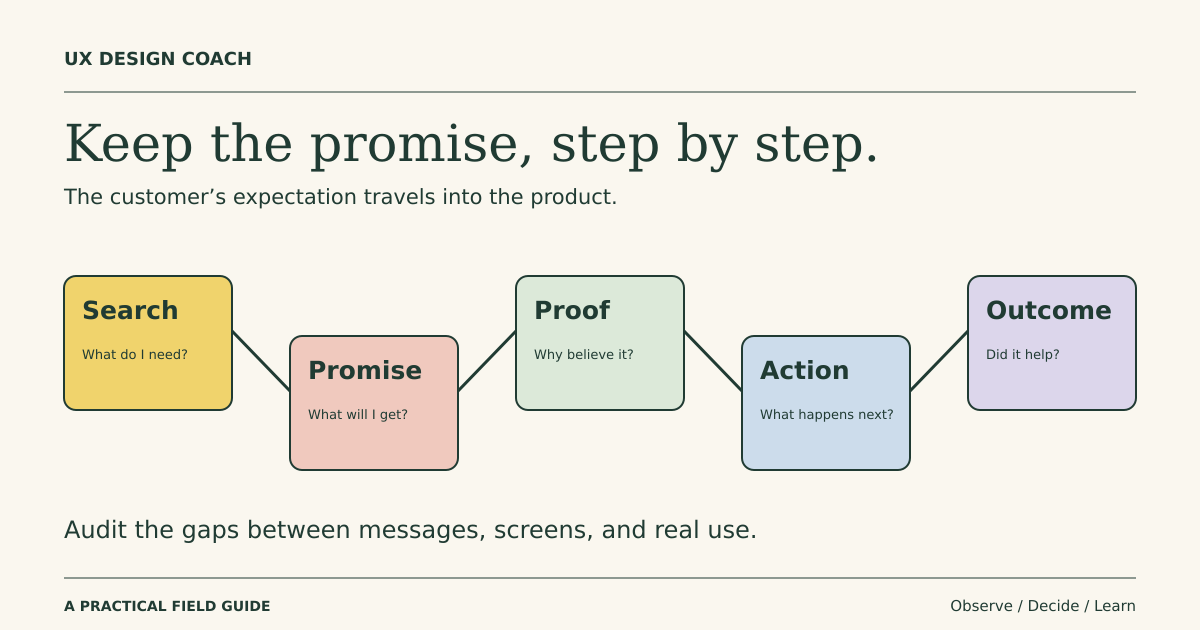
Marketing shapes what people expect before they reach an interface. A designer who understands that expectation can spot a broken promise, explain an unfamiliar concept, and remove friction from the right task. The goal is a more coherent customer experience, with commercial outcomes considered alongside usability and trust.
Start by asking how a person arrived. Someone following a tutorial, comparing providers, or responding to an urgent service ad brings a different question. The same page may need to help all three, but it should not assume they know the same vocabulary or want the same next step.
Read the journey before redesigning the screen
Collect the actual entry point, the promise it makes, and the destination. Include the query or audience context where it is available, the ad or email, the landing page, the form, the confirmation, and the first-use experience. Preserve the distinction between observed behavior and your interpretation.
Illustrative scenario: an ad offers a “free personal audit,” but its landing page opens with a paid subscription pitch and a form labeled “Get started.” The form may be perfectly usable while the overall journey remains confusing. A useful design question is whether people understand what they will receive, when, and what happens after submitting.
Do not assume the answer is a brighter button. Align the offer, explain the exchange, and show an honest confirmation. That gives the team a specific hypothesis to test.
Translate five marketing concepts into design questions
| Marketing concept | Useful UX question | Evidence to seek |
|---|---|---|
| Search intent | What question brought this person here? | Queries, interviews, entry pages |
| Positioning | Which alternative are they comparing us with? | Sales conversations, comparison behavior |
| Value proposition | Can they explain why this is useful? | Comprehension checks, customer language |
| Objection | What makes the next step feel risky? | Support questions, usability sessions |
| Activation | What is the first meaningful outcome? | Task completion, time to value, follow-up |
These are prompts for investigation, not permission to infer a person's motivations from an analytics label. A source tagged “paid search” does not tell you whether the visitor is knowledgeable, confident, or ready to buy.
Segment the evidence without inventing personas
Compare journeys by relevant context: new versus returning customers, task type, device constraints, or acquisition promise. Avoid treating demographic guesses as behavior. A designer needs to know what someone is trying to accomplish and what prevents it.
Review analytics with the person who understands the instrumentation. Ask what a conversion means, whether duplicate events are possible, and which visitors are missing from the data. Use interviews and usability work to investigate why a pattern may exist. Quantitative evidence and qualitative evidence answer different questions.
For example, a high form-abandonment rate can suggest a problem but cannot establish its cause. A field might be confusing, the offer might be unsuitable, or people might simply be checking eligibility. The next research task should distinguish those explanations.
Design the promise-to-outcome audit
Create one row for each step: entry message, page, form, confirmation, and first use. For every row, write the person's question, the claim being made, the evidence shown, and the action requested. Mark unsupported claims and unexplained transitions.
Then review failure and recovery. Can someone edit a mistaken answer? Does the form explain what information is required? Is success announced clearly? The W3C guidance on form labels and user notifications provides concrete implementation guidance for this part of the journey.
Conversion pressure does not justify hidden conditions, fabricated scarcity, or consent that is difficult to refuse. A successful flow helps an appropriate customer make an informed decision. It should also let an unsuitable customer recognize that quickly.
Choose a balanced measurement plan
Pair a business outcome with a user outcome and a guardrail. For an audit-request journey, that might mean qualified requests, accurate understanding of the offer, and complaints or unintended submissions. Define qualification before reviewing results.
If you test two designs, document the assignment method, main measure, duration assumptions, and what would make the result inconclusive. Do not call an observational before-and-after comparison a randomized experiment. Seasonal demand, channel mix, or a changed offer can explain an apparent improvement.
Use the guide to testing a redesign hypothesis to describe the limits of your evidence. The onboarding audit helps continue the investigation after signup.
A useful exercise for your next critique
Choose one real acquisition journey you are permitted to inspect. Capture five screens or messages. Write a one-sentence description of the expectation each creates. Find the largest mismatch, propose two alternatives, and name the evidence that would help choose between them.
Your deliverable is a decision brief: customer context, observed mismatch, options, tradeoffs, success measure, and next test. Include a rough prototype only if it helps answer the question. The work demonstrates how design connects customer understanding to business decisions.
Questions designers ask
Does marketing knowledge turn UX into conversion optimization?
No. It adds acquisition and business context to the design problem. Accessibility, comprehension, user control, and successful task completion remain part of good UX even when they are not the headline campaign metric.
Can analytics replace user research?
Analytics can identify patterns and help prioritize questions. It rarely explains the complete reason for a person's behavior. Use appropriate research to investigate the cause and evaluate proposed changes.
Where does this connect to forward deployed design?
A designer working closely with a customer often sees the entire journey, including promises made before implementation. Explore the forward deployed designer guide for the responsibilities and evidence that role can involve.
Want an experienced review of your next design decision?
See the deliverables, boundaries, and next step before you book.
Explore the scope ↗Keep exploring
A better-looking redesign is a hypothesis. Here is how to test it.
How to prioritize UX friction without giving your product a made-up score