What is a forward deployed designer?
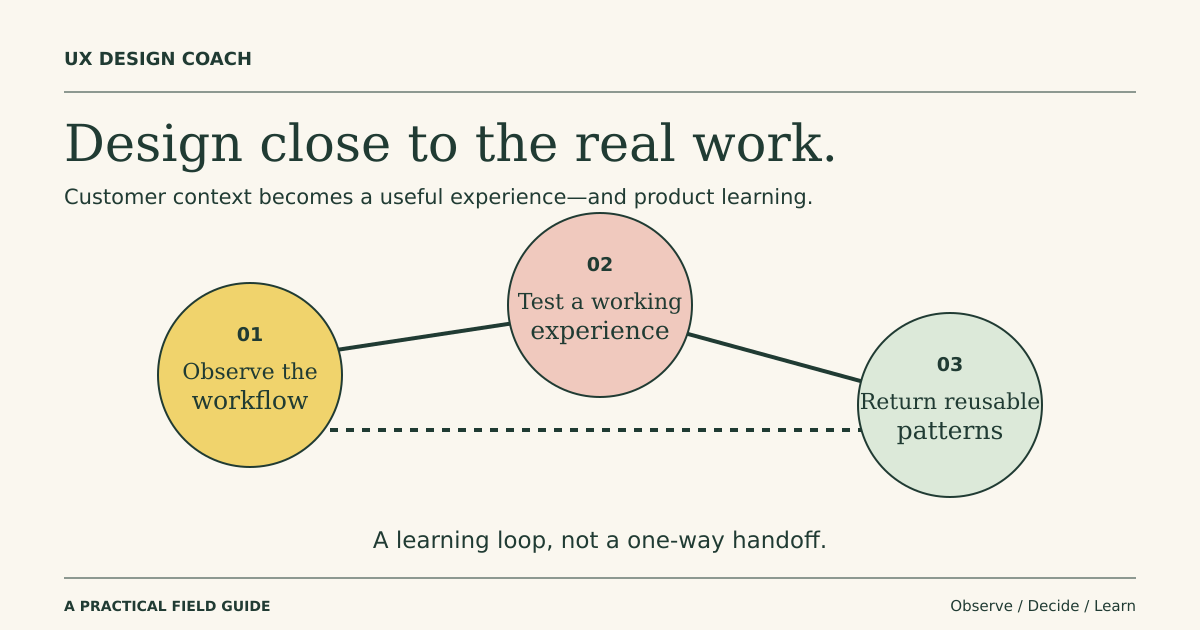
A forward deployed designer works close to a customer or operating team to turn a product's capabilities into a useful experience in that customer's context. Depending on the employer, the work can include workflow research, interaction design, prototyping, implementation collaboration, creative systems, and adoption support. Insights from delivery should inform reusable product improvements.
The title exists, but it is not a standardized profession or a universal job description. Employer listings reviewed in October 2026 include Tailor's Forward-Deployed Product Designer and Hightouch's Forward Deployed Creative Designer, Ads. Their responsibilities differ: one emphasizes customer product implementations; the other connects brand creative, AI workflows, adoption, and marketing performance.
That variation is the first thing to understand when evaluating a role. Read the work, decision rights, customer access, and delivery expectations before treating the title as a promise of a particular career path.
How does it differ from a forward deployed engineer?
Both roles work near the customer's real problem. A forward deployed engineer typically carries substantial responsibility for technical implementation, integration, and reliable operation. A forward deployed designer focuses on whether the experience fits the workflow, is understandable, and supports successful use. Some roles intentionally combine these responsibilities.
| Role | Typical center of responsibility | Evidence to inspect |
|---|---|---|
| Product designer | A product experience serving a market | Research, interaction decisions, product outcomes |
| Forward deployed designer | A customer deployment and what it teaches the product team | Workflow understanding, shipped experience, adoption, reusable patterns |
| Forward deployed engineer | A working technical solution in the customer's environment | Integration, code, reliability, operational outcomes |
| Design engineer | The bridge between design craft and implementation | Interactive work, component quality, technical execution |
These boundaries overlap. A designer who writes code is not automatically forward deployed, and a customer-facing workshop does not by itself establish the full role. Look for sustained ownership of the path from customer context to a useful deployed outcome.
What the work can look like
Consider an illustrative software rollout for a support operation. The product has a queue, assignments, and reporting. The customer has shift changes, exceptions, permissions, and an escalation process that the demo did not reveal.
The designer observes the work with permission, maps the handoffs, and identifies an ambiguous ownership state. With engineering and the customer owner, they prototype a clearer assignment and escalation flow. They test it with representative users, inspect the implementation, and track whether people can complete the task. A reusable exception pattern then goes back to the core product team.
The output includes screens, but the important evidence is the chain of decisions: what was learned, which tradeoff was made, what shipped, and what remained uncertain. The role also needs an exit: named owners, documentation, and a team that can operate the workflow afterward.
Skills worth developing
Practice contextual research and facilitation, especially with people whose job is different from yours. Learn to ask for a recent example, trace the actual workflow, and distinguish an inconvenience from a costly failure. Write findings so another team member can inspect the evidence.
Build interaction and prototyping skills that handle permissions, empty states, loading, errors, and recovery. Develop enough technical literacy to discuss data dependencies, integration constraints, component reuse, and delivery risk. The coding depth required depends on the role; some employers expect production implementation, while others expect close partnership with engineers.
You also need commercial judgment. Understand the customer's desired outcome and the vendor's product boundaries. One valuable customer request can still be the wrong permanent feature. Explain what should be configured, tested, generalized, deferred, or declined.
Build a portfolio around decisions and delivery
Use a case study structure that makes your own contribution clear:
- Context: customer type, task, constraints, and what you were authorized to do.
- Evidence: observations, source material, and assumptions kept separate.
- Decision: alternatives, rationale, and the tradeoff you accepted.
- Execution: prototype, implementation collaboration, and quality checks.
- Outcome: what was measured, what was only observed, and what cannot be concluded.
- Transfer: documentation, reusable patterns, and ownership after delivery.
If you are practicing, label the work as a simulation and use synthetic data. You can demonstrate judgment through a careful prototype and evaluation plan without claiming that a customer deployed it. See how to write a case study without invented metrics.
Questions to ask before accepting an engagement
Will you have access to actual users or only executive summaries? Who decides scope when requests conflict? Is coding part of the role, and who reviews production changes? How much travel is expected? What customer data can you access? Who owns ongoing support? How do field observations reach the product roadmap?
Ask how success is evaluated. A list of screens delivered can miss whether the customer adopted the workflow. Conversely, revenue or adoption targets may depend on factors outside your control. Agree both the outcomes you influence and the responsibilities you actually own.
Your practice assignment
Choose a bounded workflow, such as booking a consultation or resolving a support exception. Create a workflow map, an interactive prototype with one failure state, a test plan, and a one-page handoff. Use the design handoff checklist to review what is missing. Then explain one reusable pattern and one thing that should remain customer-specific.
Common questions
Is this just a new name for consulting?
There is overlap with embedded consulting, implementation design, and solutions work. The useful distinction is customer proximity plus responsibility for making a particular deployment useful and feeding learning back into the product. Titles alone do not guarantee that model.
Do I need to be a full-stack developer?
Not for every role. Evaluate the actual implementation requirements. Technical fluency and productive collaboration matter broadly; production coding expectations vary by employer.
Does the title guarantee strong demand or a salary level?
No. Public examples establish that the role exists, not the size of the market or what a specific employer will pay. Compare responsibilities, compensation, location, and travel directly with the employer.
Primary examples and further reading
- Tailor: Forward-Deployed Product Designer
- Hightouch: Forward Deployed Creative Designer, Ads
- Palantir: software engineering and forward deployed engineering
Employer examples were checked October 14, 2026; listings can change. The portfolio exercise and comparison framework are UX Design Coach editorial guidance.
Want an experienced review of your next design decision?
See the deliverables, boundaries, and next step before you book.
Explore the scope ↗Keep exploring
A better-looking redesign is a hypothesis. Here is how to test it.
How to prioritize UX friction without giving your product a made-up score