Research practice
Make AI a research sounding board, not a source of imaginary users
Use AI to challenge research plans and syntheses while keeping real observations, interpretations, and generated possibilities clearly separated.

In this guide
- The useful starting point
- Keep four kinds of material separate
- Use AI before the session
- A fictional example: confusing export behavior
- Use a prompt that invites disagreement
- Build a traceable synthesis
- Protect the participant and the meaning
- Recover when AI becomes too agreeable
- Make the sounding board part of your craft
- Questions you might be asking
- Sources and further reading
The useful starting point
Ask AI to critique your questions, identify alternative explanations, and trace findings to approved source material. Treat simulated users and generated feedback as hypotheses, then validate important conclusions with real participants and observed behavior.
Research often involves sitting with uncertainty. A participant says one thing and does another. Two interviews seem to contradict each other. The team wants an answer before the evidence is ready. AI can be a useful sounding board in that space if you give it the right role.
Its job is to help you ask better questions and inspect your reasoning. It should not create the appearance of research that never happened.
Keep four kinds of material separate
| Material | Example | How to use it |
|---|---|---|
| Observation | A participant could not locate the save action | Describe what happened and its context |
| Participant report | A person said they usually ask a colleague | Explore the experience and its limits |
| Researcher interpretation | The wording may not match their expectation | State as an explanation to examine |
| Generated possibility | AI proposes another reason for the behavior | Use to plan a check, not as a finding |
That distinction should survive every summary and presentation. A polished synthesis is less useful if the reader cannot tell where the claims came from.
Use AI before the session
Share the research objective, relevant context, and draft discussion guide using approved information. Ask the assistant to identify leading questions, vague wording, double questions, and assumptions about the participant's behavior.
For example, “How much easier would this feature make your work?” assumes both that it helps and that the person can predict its effect. A more useful prompt might ask about the last time they handled the task, then explore the specific steps and difficulties.
You can rehearse the guide with a simulated response to notice awkward transitions. Label that rehearsal clearly. It does not tell you what real participants will say or validate the topic's importance.
A fictional example: confusing export behavior
Imagine a researcher studying a reporting tool. Two participants try to export a table by selecting a menu near the chart. One uses the page-level menu successfully. Another asks whether exporting includes private notes.
AI proposes the finding “Users want a larger export button.” The researcher returns to the evidence. The observations suggest several issues: location expectations, uncertainty about scope, and concern about what information leaves the system.
She asks the assistant to generate alternative explanations and questions for the next sessions. The output includes “What did you expect this export to contain?” and “Show me where you would look first.” Those questions help investigate the observed uncertainty without treating a particular button change as the answer.
The fictional example illustrates why a synthesis should preserve detail. A quick summary can compress different problems into one attractive design recommendation.
Use a prompt that invites disagreement
Act as a careful research reviewer. Use only the approved notes below. Separate observations, participant statements, my interpretations, and new hypotheses. For each proposed finding, identify supporting examples, contradictory examples, and missing context. Flag leading questions and unsupported generalizations. Suggest the next question or observation that could change our conclusion. Do not invent participants, quotations, frequencies, or findings.
Then ask, “What important detail did the summary remove?” That can reveal variation between participants or a constraint that disappeared when the notes became a theme.
Build a traceable synthesis
- Keep source references. Attach each observation to an approved note, session, or excerpt identifier.
- Group cautiously. Ask AI to propose themes while preserving examples that do not fit.
- Inspect the originals. Review the source material before accepting a theme.
- Describe scope. State which participants and situations the finding covers.
- Separate recommendation. A design proposal should follow the finding, not replace it.
- Record uncertainty. Identify what the current research cannot answer.
Counts can be useful when reported accurately, but a few interviews should not become a population percentage. Avoid asking AI to manufacture precision from qualitative material.
Protect the participant and the meaning
Use only tools and data handling that fit the research agreement and your organization's requirements. Remove unnecessary identifying details. A transcript may include personal information that does not belong in a general-purpose workflow.
Check quotations directly. A paraphrase should be labeled as a paraphrase, and a generated phrase should never appear as something a participant said. If the assistant changes a meaningful word, correct the record before sharing.
Be particularly careful when summarizing emotion or intent. “The participant paused for ten seconds” is different from “The participant felt intimidated.” Explore interpretations without presenting them as direct observations.
Recover when AI becomes too agreeable
If it praises your conclusion without challenging it, ask for the strongest evidence against the conclusion. If it produces generic criticism, require specific links to the supplied material. If it repeatedly confuses source statements with your interpretation, simplify the input and use explicit labels.
Bring another researcher or teammate into important decisions. A second model response is not the same as independent human review, especially when both responses rely on the same incomplete context.
If the synthesis fails, return to the source notes and rebuild one theme at a time. You do not need to discard all assistance; narrow the assistant's role to organizing excerpts or checking a discussion guide.
Make the sounding board part of your craft
Keep the questions that consistently improve your work: What else could explain this? Which participant contradicts the theme? What would we need to observe to change our mind? Which conclusion is stronger than the evidence?
These habits matter beyond any particular tool. AI can help you practice them more often, but the research still depends on respectful encounters with real people and careful interpretation of what actually happened.
Questions you might be asking
Can I use an AI persona as a research participant?
Use it for rehearsal or generating possibilities, clearly labeled as synthetic. It cannot establish how real people behave or what they need.
Can AI summarize interview notes?
Yes, when the material is approved for that use. Preserve source references and inspect important themes, quotations, omissions, and contradictions against the originals.
How do I stop AI from just agreeing with me?
Ask for specific contradictory evidence, alternative explanations, and a test that could change your conclusion. Require references to supplied material rather than generic criticism.
Sources and further reading
- Microsoft appropriate reliance research
- Microsoft human-AI interaction guidelines
- Anthropic evaluation guidance
Sources checked October 16, 2026. Review the linked publisher information for current details.
Put one idea to work
Take the next step with a practical worksheet, a clear research question, and a standard you can use to review the work.
Explore design worksheets →Explore more from UX Design CoachGet design practice in your inbox →Keep practicing
 Design review
Review an AI-generated landing page before the client handoff
A practical review that checks the visitor task, claims, keyboard journey and handoff notes before a polished draft becomes a live page.
October 18, 2026 · 3 min read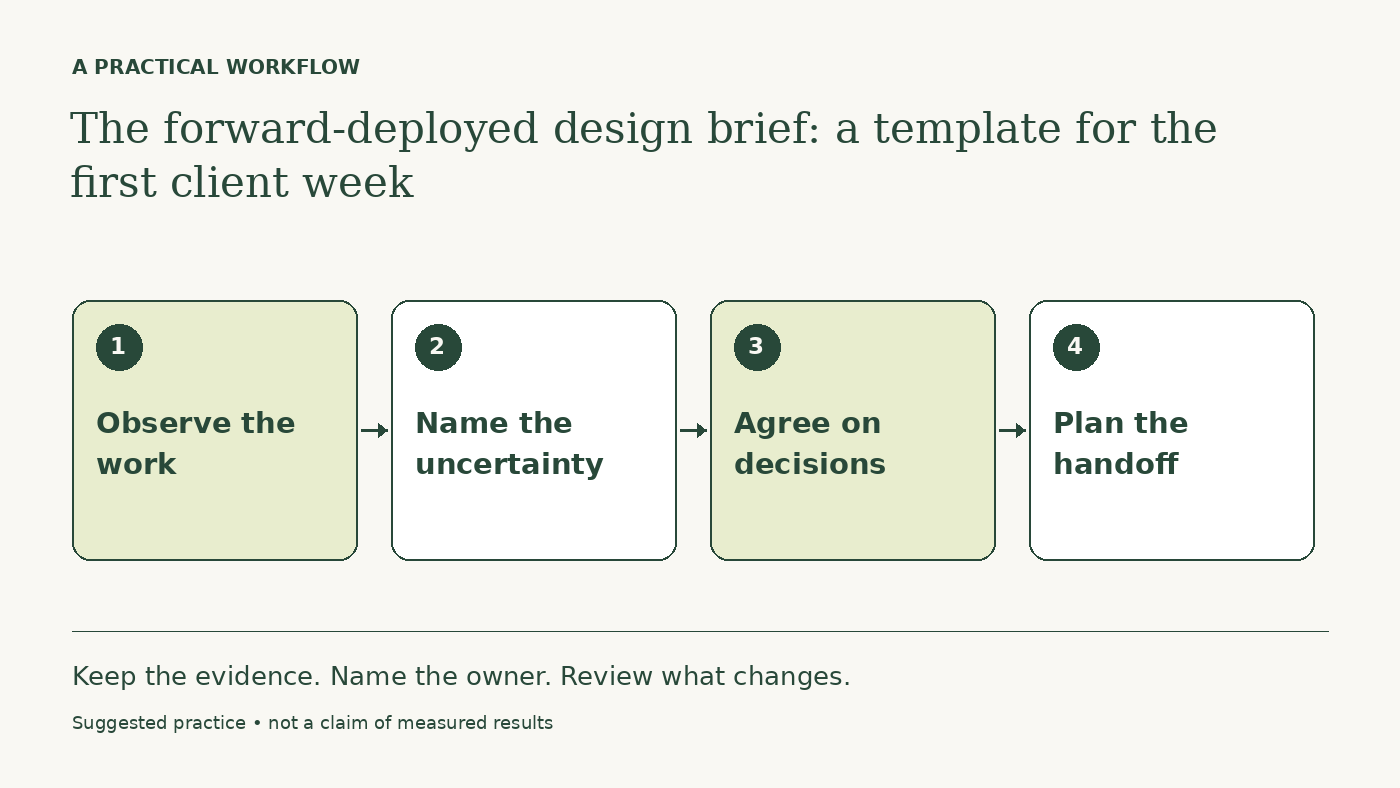 Forward-deployed design
The forward-deployed design brief: a template for the first client week
Define the workflow, research access, decision rights, and handoff before an embedded designer starts producing screens.
October 16, 2026 · 4 min read